


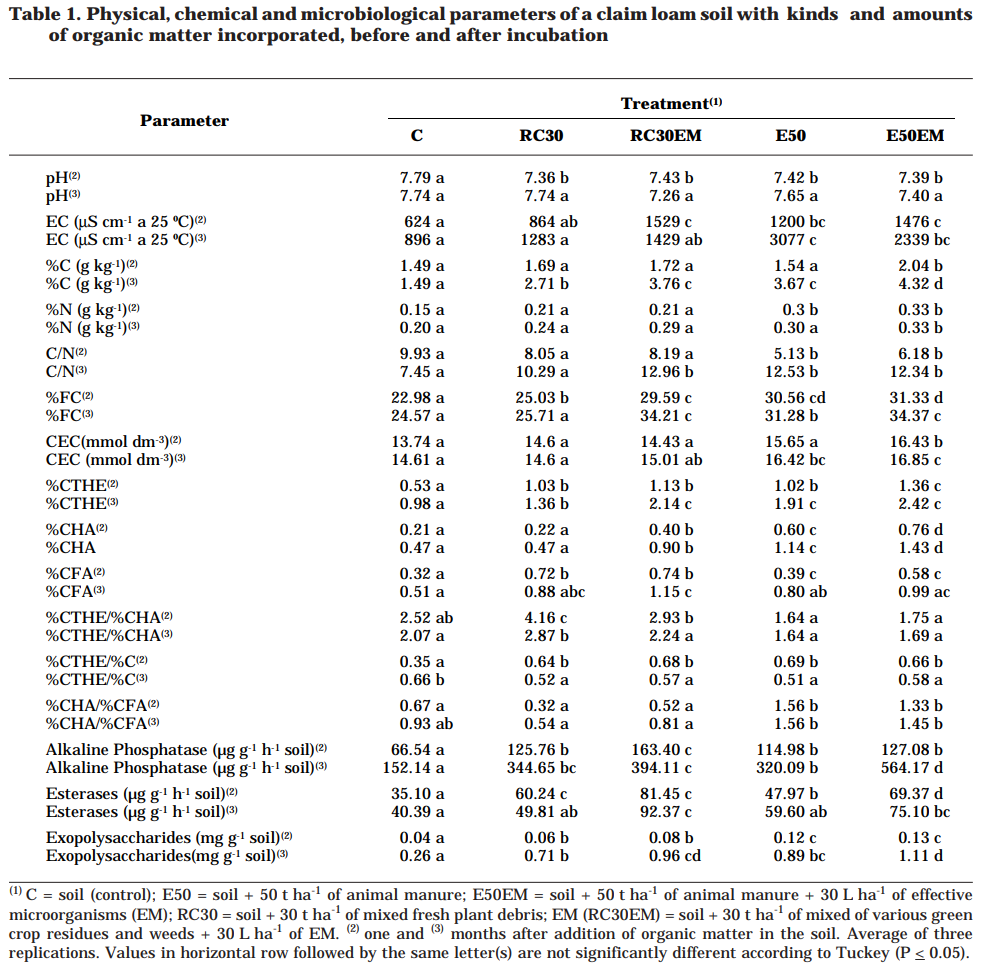
In Spain a trial (Valarini, Diaz Alvarez, Gasco, Guerrero, & Tokeshi, 2003) conducted in Madrid, evaluated the properties of a clay loam soil enriched with organic matter and microorganisms under controlled temperature and moisture conditions, over a period of three months. The following treatments were carried out: soil (control); soil + 50t/ha of animal manure (E50); soil + 50t/ha of animal manure + 30L/ha of effective microorganisms (E50EM); soil + 30t/ha of the combination of various green crop residues and weeds (RC30) and soil + 30t/ha of the combination of various green crop residues and weeds + 30L/ha of effective microorganisms (RC30EM). Soil samples were taken before and after incubation and their physical, chemical, and microbiological parameters analysed.
A significant increase was observed in the production of exopolysaccharides and basic phosphatase and esterase enzyme activities in the treatments E50EM and RC30EM, in correlation with the humification of organic matter, water retention at field capacity, and the cationic exchange capacity (CEC) of the same treatments. The conclusion was drawn that the incorporation of a mixture of effective microorganisms (EM) intensified the biological soil activity and improved physical and chemical soil properties, contributing to a quick humification of fresh organic matter. These findings were illustrated by the microbiological activities of exopolysaccharides and by alkaline phosphatase and esterase enzymes, which can be used as early and integrated soil health indicators

The long-term soil amendments caused significant changes in soil physical-chemical properties (Table 1). Soil bulk density and pH were significantly (p < 0.05) lower in the two compost plots than in the control plot. Moreover, soil pH was significantly (p < 0.05) lower in the EM compost plot than in the traditional compost plot. Soil organic matter, total N, alkaline-hydrolysable nitrogen, and available K content was significantly (p < 0.05) higher in the two compost plots than in the control plot. Soil available P and K content was significantly (p < 0.05) higher in the EM compost plot than in the traditional compost plot.
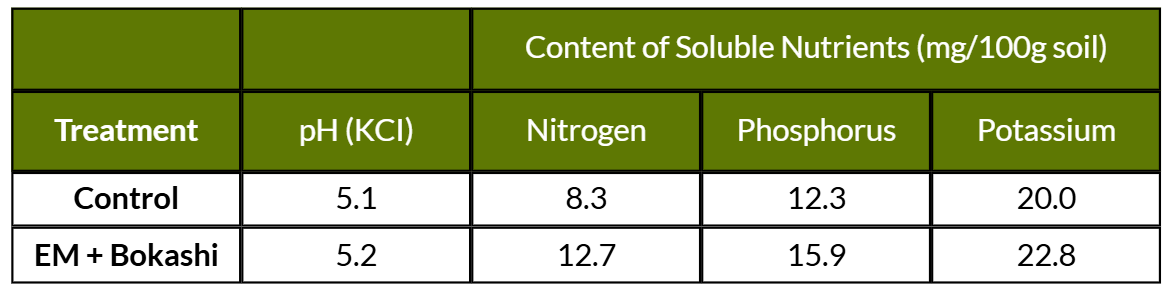
Another trial (Lim, Pak, & Jong, 1997) conducted in Korea, looked at the effect of EM treatment on the content of nutrients in the soil. The EM treatment increased the content of soluble nutrients. The contents of soluble nitrogen, phosphorous and potassium increased 4.4, 3.6 and 2.8 mg/100g soil, respectively. The increase of soluble N, P and K contents might be attributed to activity of nitrogen fixers and organic acids excreted by the different organisms in EM.
Key Findings
-

Enhanced Nutrient Availability
Improved nutrient release and cycling through increased microbial activity and organic matter breakdown.
-

Stronger Soil Biology
Increased biological activity supported healthier root systems, improved soil function and long-term fertility.
-

Reduced Fertiliser Dependence
Trials showed equivalent or improved crop performance with reduced synthetic nitrogen inputs.


View our other Trials
-

Independent Trials
View TrialsIndependently managed, harvested or analysed New Zealand field trials demonstrating the commercial performance of EMNZ biological technologies under real farming conditions.
-

EMNZ Replicated Field Trials
View TrialReplicated commercial field trials conducted by EMNZ to evaluate biological performance across a range of New Zealand arable, forage, horticultural and pastoral systems.
-

Historical Innovation Trials
View TrialsFoundational research and development trials that helped shape the modern EMNZ product range and our understanding of biological farming systems.
-

International Research Support
View TrialsPeer-reviewed international research supporting the role of Effective Microorganisms (EM) in soil biology, nutrient cycling, plant performance and crop resilience.


