



An Effective Plant Strengthening Agent for Tomatoes in Protected Cultivation
In this trial (Ndona, Friedel, Spornberger, Rinnofner, & Jezik, 2011) conducted by the University of Natural Resources and Life Sciences Vienna, Austria, looked at the effect of EM on tomato yeild and also the effect on fruit quality and disease. The results showed that the total yield was higher and the number of fruits damaged by blossom-end rot was reduced in the EM-treated plants. The percentage of fruits in the best quality class, was also significantly higher.

Application of EM on Nutrient Contents In Leaves And Yielding of Tomato
The aim of this study (Kleiber, et al., 2014) was to evaluate the effect of applying Effective Microorganisms (EM), on macro element contents in leaves and yield of tomato grown in a peat substrate. Application of EM had a significant effect – when applied either as seed inoculation or combined seed inoculation + spraying of plants, an increase of total and commercial yields of tomato (35.8% and 40%; 44.6% and 35.9%, respectively).
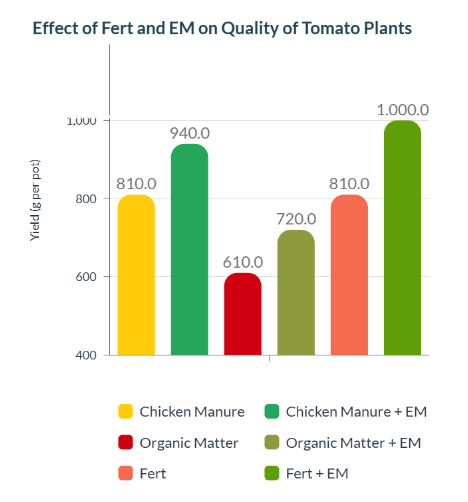
This trial (Xu, Wang, & Mridha, 2008) published in the Journal of Crop Production, looks at Effects of Fertilisers and a Microbial Inoculant on Leaf Photosynthesis and Fruit Yield and Quality of Tomato Plants. The trial showed that EM Inoculation increased plant growth and fruit yield in all treatments. In this study, available phosphorus concentration. 50 days after transplanting were higher in EM treated soils than untreated soils. This might be associated with the activities of the EM microbes. However, 90 days after planting, the nitrogen and available phosphorus concetrations were lower in EM-treated soils. This might be associated with more absorbtion of the nutrients by the plants that showed faster growth and higher fruit yield in EM-treated plots than untreated plots. Other areas to note from this study showed EM increased photosynthetic activity in the plants and vitamin C concentration in tomato fruit.
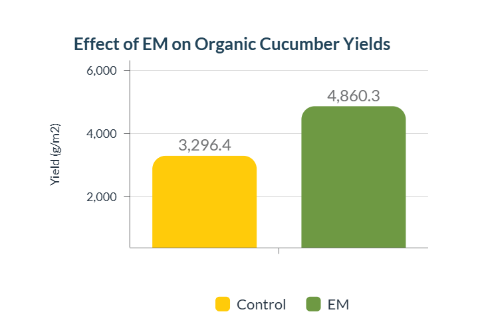
This trial by the School of Natural Resource, university Missouri, USA , looked at using EM to boost yield and reduce the incidence of pickleworm in Cucumbers. The results showed the EM both increased yield and reduced the incidence of disease and pest damage, in both cases the effect of EM was significant over the control. The potential use of EM for pest management while enhancing yields was confirmed in this trial.
Key Findings
-

Stress Resilience & Recovery
Helps plants recover from environmental stress and maintain performance.
-

Enhanced Photosynthesis
Supports chlorophyll activity, energy production and stronger crop growth.
-

Root & Nutrient Uptake
Encourages deeper rooting and improved nutrient and water efficiency.


View our other Trials
-

Independent Trials
View TrialsIndependently managed, harvested or analysed New Zealand field trials demonstrating the commercial performance of EMNZ biological technologies under real farming conditions.
-

EMNZ Replicated Field Trials
View TrialReplicated commercial field trials conducted by EMNZ to evaluate biological performance across a range of New Zealand arable, forage, horticultural and pastoral systems.
-

Historical Innovation Trials
View TrialsFoundational research and development trials that helped shape the modern EMNZ product range and our understanding of biological farming systems.
-

International Research Support
View TrialsPeer-reviewed international research supporting the role of Effective Microorganisms (EM) in soil biology, nutrient cycling, plant performance and crop resilience.


