

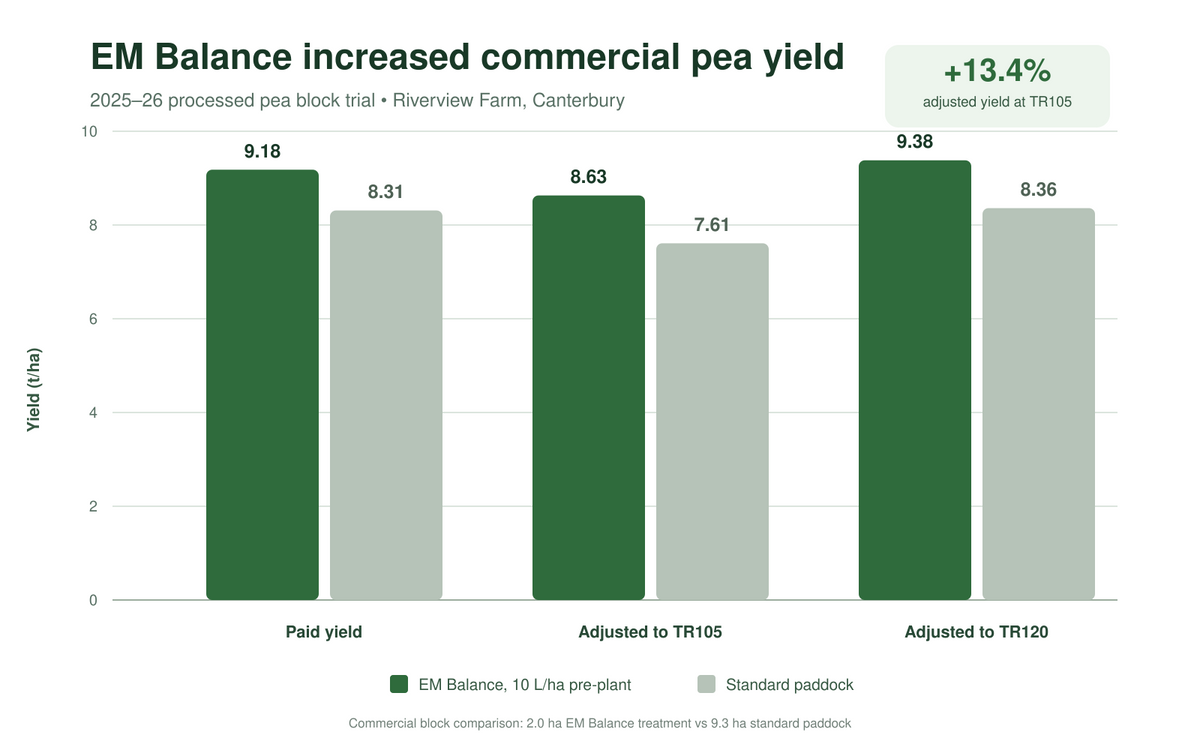
A commercial-scale Canterbury trial found that a single pre-plant application of EM Balance increased processed pea yield without adversely affecting crop maturity or raw-material quality.
The 2025–26 trial was conducted in a Wattie’s production crop at Riverview Farm and evaluated under normal commercial growing, harvesting and factory-processing conditions.
The trial was established during the 2025–26 processed-pea season to evaluate EM Balance under commercial production conditions.
A marked 2-hectare area received EM Balance at 10 L/ha prior to planting. The remainder of the 9.3-hectare paddock acted as the standard comparison.
Both areas were:
- Direct-drilled following grass
- Planted in the Ashton pea variety
- Managed under the same standard crop programme
- Irrigated as required
- Harvested commercially
- Assessed through normal crop-reception and factory processes
The EM Balance block was harvested separately, allowing its yield, maturity and crop-quality results to be compared with the standard paddock.
Key Findings
-

Yield
EM Balance increased yield by 13.4% and over 1t/ha
-

Crop Performance
Improved yield without compromising quality - the increased yield was achieved without delaying crop maturity or negatively affecting the peas’ suitability for processing.
-

Commercial Relevance
At a cost of only $30 per ha EM Balnce signifcantly increased grower profit


Improved yield without compromising quality
Use a featured-text block.
The increased yield was achieved without delaying crop maturity or negatively affecting the peas’ suitability for processing.
Crop-reception assessments found no adverse effect on:
- Crop maturity
- Overall blemish levels
- Pea discolouration
- Pest or climatic damage
- Factory grading and processing
There were no obvious visual differences recorded in the field or during harvest. The peas graded and processed through the factory as normal.